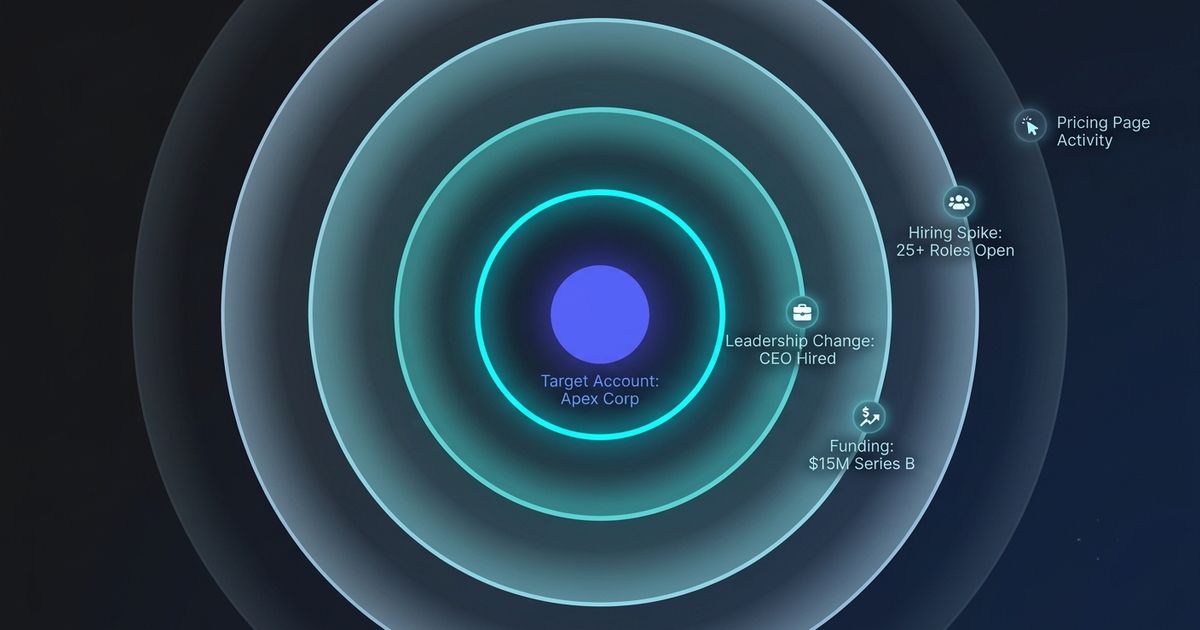
The Triggers That Predict Buying Intent (And What "Signal-Based" Actually Means
BLOG · Sales Automation · BUYING INTENT
Est. read time: 8 min · Last updated: JULY, 2026
"Signal-based outreach" gets used constantly in outbound advice right now. It's rarely defined. Most teams know the phrase without knowing the mechanics — which triggers actually predict intent, how long each one stays valid, or why stacking them matters more than chasing any single one.
That gap is worth closing because the number behind it is too large to treat as a buzzword.
The Stat That You Can’t Ignore
Generic cold email averages a 3.43% reply rate. Emails that reference a specific trigger event, i.e. something that actually happened at the account, not a demographic assumption, achieve 18% response rates. That's over 5x the baseline, from a large independent dataset, not a single vendor's client results.
The gap isn't about better writing. It's about what the email is anchored to before it's written.
FAQ: Buying Signals and How They Work
What is a buyig signal in B2B sales?
A buying signal is an observable event at a company that indicates a purchase decision is more likely than it was before, such as a leadership change, a funding round, a hiring surge, or a tech stack shift. It's different from a demographic attribute like company size or industry, which stays static and tells you nothing about timing.
How long does a buying signal stay valid before it expires?
It depends entirely on the signal type. Some hold value for weeks, others for days. A funding announcement stays relevant for roughly a month. A pricing page visit loses most of its value within under two weeks. There's no universal decay window; the mistake most teams make is treating every signal as equally time-sensitive when they aren't.
Does stacking multiple signals actually improve reply rates?
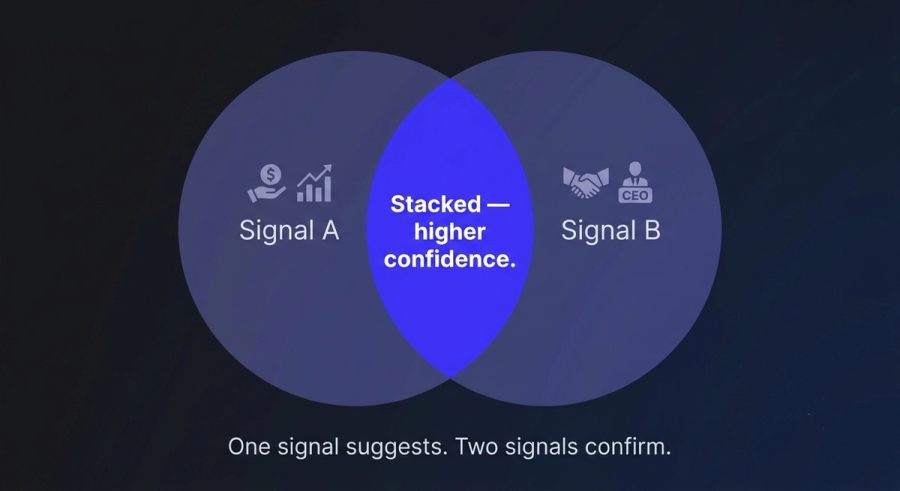
Yes, and the difference is significant. A single signal on its own has a real but modest predictive value; it flags genuine intent roughly one time in five. Two independent signals on the same account, in the same window, roughly triple that reliability. This is why single-signal outreach ("they raised funding, therefore email them") consistently underperforms outreach gated by two or more corroborating signals.
What's the difference between intent data and a buying signal?
Intent data is behavioural exhaust. Pages visited, topics researched, content consumed, usually aggregated by a third party. It answers "who is researching?" A buying signal is a discrete, dateable event such as a funding round, a job change, or a hiring post. It answers "what just happened that changes their priorities?" The strongest outbound motions use intent data to narrow the field and buying signals to trigger the actual send.
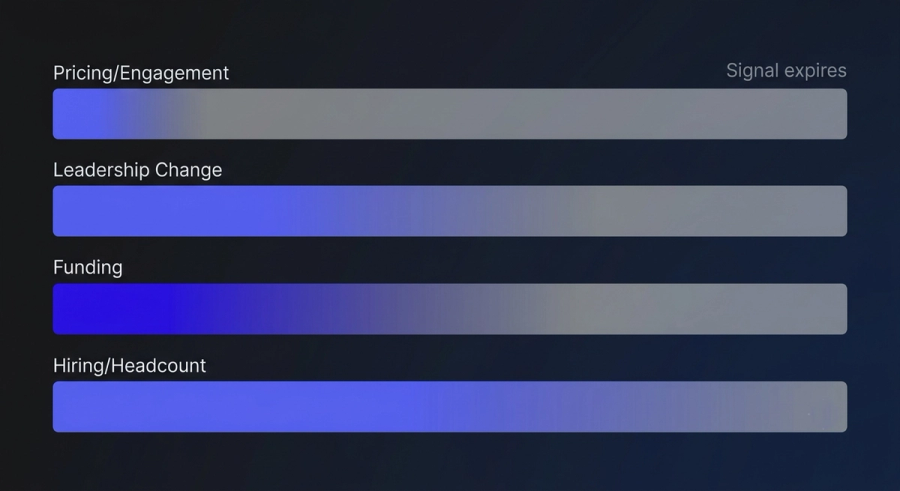
The trigger stack, ranked by evidence and decay
Not all signals carry equal weight, and not all of them expire at the same speed. Here's how the strongest ones stack up:
Leadership or role change
A new VP or department head typically opens a 30–90-day window where they're actively evaluating tools and proving early wins. Outreach in the first 30 days after a role change converts roughly 3x better than outreach sent later. The window closes as the new hire settles into existing systems. This is consistently ranked among the highest-converting single signals across independent sources.
Funding events
A funding round signals fresh budget and pressure to scale. The window is strongest in the 2–4 weeks immediately after the announcement; after that, the money is typically already earmarked for existing priorities, and a cold pitch referencing a funding round from two months ago reads as stale rather than timely.
Hiring or headcount surges
Sustained headcount growth meaningfully above baseline over 90 days correlates strongly with new tooling and infrastructure purchases. This is a slower-burning signal than the two above: it's less about a single dateable event and more about a sustained trend, which makes it useful for medium-term prioritisation rather than same-week urgency.
Pricing page visits and direct engagement
These are the shortest-lived signals of the group, typically losing predictive value within days rather than weeks. They're also the most direct: a prospect actively looking at pricing is closer to a decision than one who merely fits a demographic profile. Speed matters more here than with any other trigger type.
A sourcing note worth being direct about: the leadership-change and headcount figures above come from independent analyses of real prospect and purchase data. Some of the broader benchmark ranges circulating in 2026 outbound content come from vendors selling signal-detection tools, who have a commercial interest in the numbers they publish. The relative ranking of leadership change and funding events outperforming generic engagement signals holds up across both types of sources. The precise multipliers are worth treating as directional rather than exact.
Why stacking beats chasing any single signal
Here's the part most signal-based advice skips: a single signal, treated in isolation, is a weak filter. A funding round alone surfaces hundreds of accounts in a given week, and most of them were never going to buy from you specifically; the round might be earmarked for hiring, not new tooling.
The reliability jumps considerably when two independent signals land on the same account in the same window, a leadership change plus a hiring surge, or a funding round plus a tech stack change. That combination is a meaningfully stronger predictor than either signal alone, because it corroborates rather than just suggests.
This is the mechanical reason signal-based outreach outperforms generic AI outreach by the margin the data shows. It's not that the copy referencing a trigger is inherently better written. It's that the trigger itself has already done the qualifying work a demographic filter never could.
What to actually look for?
Don't just check whether you're using signals. Check the gap between when a signal fires and when your outreach goes out. A leadership change referenced three weeks after the fact reads as stale, not timely. The same signal, acted on too late, produces a reply rate close to that of a cold email with no signal at all.
If you're chasing single signals without a second corroborating one, that's the next thing worth fixing, but not by adding more signal sources, but by gating outreach on at least two before it sends.