Why a Strong Buying Signal on the Wrong Account Is Still Noise?
BLOG · OPERATIONAL EFFICIENCY · BUYING SIGNAL
Est. read time: 7 min · Last updated: JULY, 2026
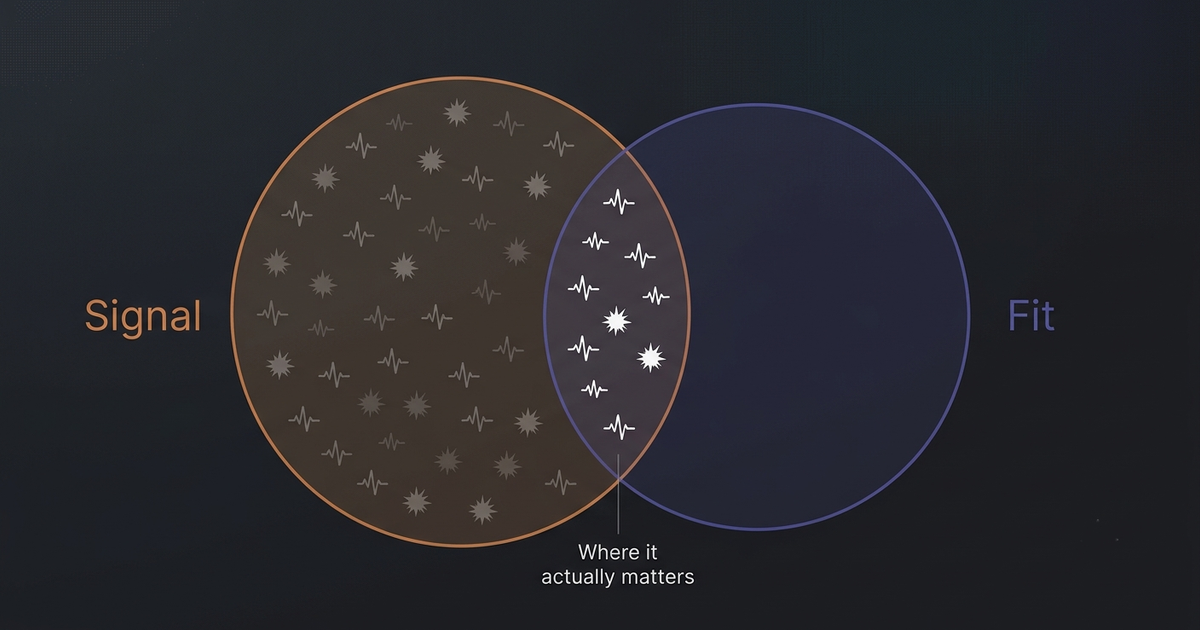
A signal tells you something happened. It doesn't tell you whether the account was ever going to buy from you in the first place. Treating every signal as equally worth acting on is how teams end up chasing engaged, responsive, entirely wrong-fit accounts, and calling it progress.
This is the piece most signal-based outreach advice leaves out. A trigger event increases urgency. It says nothing about fit. Without a fit check running alongside it, a strong signal on a poor-fit account isn't a smaller opportunity. It's a false positive.
The number that makes the case
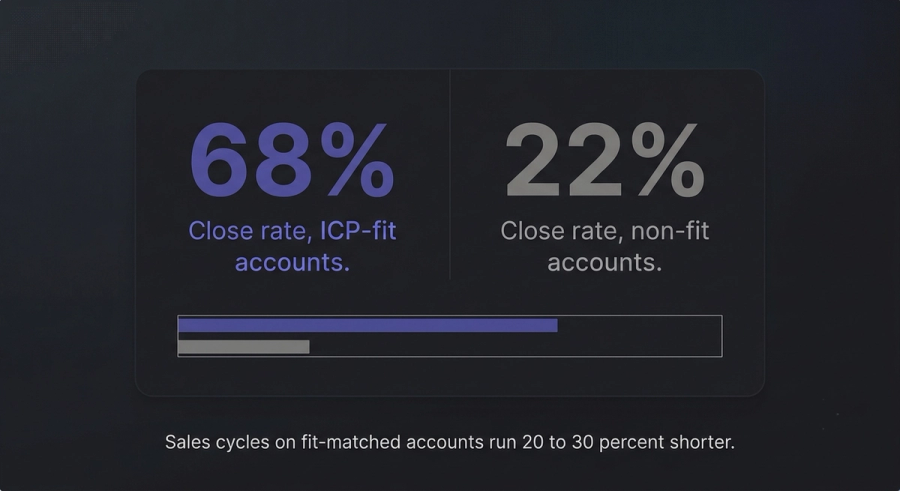
Deals sourced from accounts that match a company's ideal customer profile close at 68%, compared to 22% for accounts that don't. Sales cycles on fit-matched accounts also run 20 to 30% shorter. The gap isn't about how engaged the account was. It's about whether the account was ever a real candidate to buy.
This is why fit has to be checked before a signal gets acted on, not after. A signal on a fit-matched account is worth pursuing immediately. The same signal on a poor-fit account is worth ignoring, no matter how strong it looks.
FAQ: ICP-fit gating and buying signals
What is ICP-fit gating in B2B sales?
ICP-fit gating means checking whether an account matches a company's ideal customer profile before acting on any buying signal it produces. It separates the question "did something happen at this account" from the question "was this account ever going to buy from us." A signal only becomes worth acting on once both are true.
Can a lead have high intent but still be a bad fit?
Yes, and this is one of the most common routing mistakes in B2B outbound. A single person at a company can attend every webinar, open every email, and download every asset, generating a high engagement score. If that company doesn't match the buyer profile, none of that activity predicts a closed deal. Engagement measures interest from a person. Fit measures whether the company behind that person could ever become a customer.
What's the difference between lead scoring and ICP scoring?
Lead scoring typically measures individual behavior: email opens, page visits, content downloads. ICP scoring measures the company itself: industry, headcount, revenue band, tech stack, growth stage. A framework that combines both usually separates them into two distinct measures rather than blending them into one number, because a person and a company don't answer the same question.
How much of outbound or ad spend is typically wasted on non-ICP accounts?
One analysis of B2B SaaS ad spend across dozens of accounts found over a third of budget went toward traffic that never matched the company's ideal customer profile. The pattern repeats in outbound: signal-triggered sends that go out without a fit check waste effort on accounts that were structurally never going to convert, regardless of how well-timed the trigger was.
The clearest version of the problem
Picture a mid-level employee at a five-person startup. They open every email in a sequence, attend every webinar, and download every gated asset a company publishes. By any standard intent-scoring model, this looks like a hot lead.
But the company they work for has five employees and no budget for a tool built for mid-market teams. Traditional lead scoring calls this person hot. A model that checks fit as well as intent flags the account itself at roughly 15 out of 100, because the account was never a plausible buyer no matter how engaged the person inside it became.
This is the mechanism behind the idea that a signal without fit is still noise. The signal is real. The engagement is real. None of it changes the underlying fact that the account structurally can't become a customer. Acting on the signal anyway doesn't just waste a send. It occupies time that could have gone toward an account that actually could have closed.
How fit gating actually works
The operational fix is to score two things separately instead of blending them into one number.
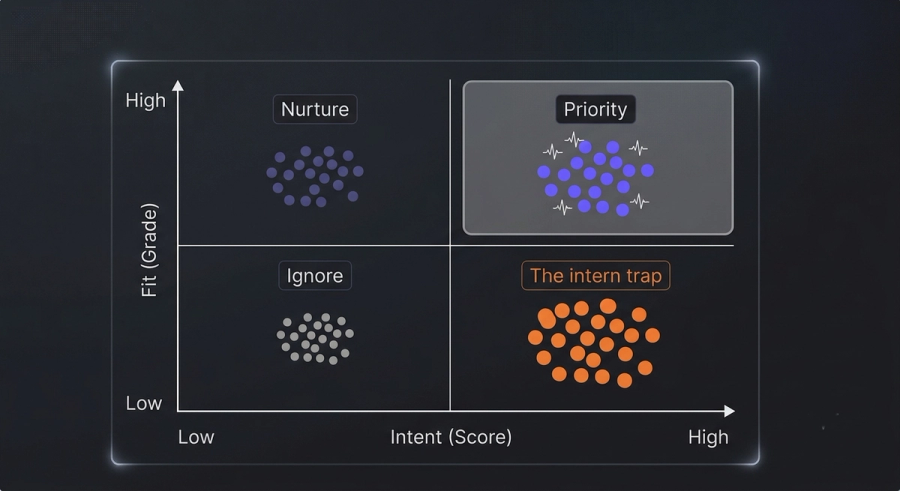
Grade measures fit: will this account ever buy, based on firmographic and structural characteristics that don't change week to week. Score measures intent: is this account showing signs of buying right now, based on signals and engagement that do change.
An account with a strong grade and a high score is the clearest priority available. It matches the buyer profile and is actively showing intent. An account with a weak grade, even alongside a high score, is one to deprioritize regardless of how active it looks, because the fit problem doesn't resolve itself no matter how many signals stack on top of it.
This two-axis approach is what prevents the routing mistake described above. A single blended score can't distinguish between an account that's a great fit but quiet right now, and an account that's a terrible fit but extremely active. Splitting fit from intent makes that distinction explicit instead of burying it inside one number.
What to check this week
Look at whichever accounts your current process flags as hot or high-priority. Check how many of them would still qualify if fit were scored separately from intent, rather than folded into the same number.
If a meaningful share of your hot accounts turn out to be highly engaged but poorly fitted, the fix isn't a better signal source. It's adding the fit check that should have run before the signal ever triggered outreach in the first place.
This closes out the pattern the last several posts have been building toward. Smaller, tighter lists outperform larger ones because they concentrate on better fit accounts. Signal based outreach outperforms generic outreach because it times the send to a real event. Fit gating is the piece that connects both. Signals tell you when to act. Fit tells you whether the account was worth acting on at all.