Why AI Cold Emails Get Ignored Before They're Even Read
BLOG · Sales Automation · AI COLD EMAILS
Est. read time: 7 min · Last updated: JULY, 2026
Your open rate looks fine. Your subject line tested well. Your copy is clean, personalised, and on-point.
And yet, nothing.
The problem isn't your email. It's the shape of it. In 2026, buyers aren't ignoring AI-generated cold emails because the writing is bad. They're ignoring them because they recognise what they are before they finish the first sentence.
That's a different problem, and it has a different fix.
The gap that makes the case
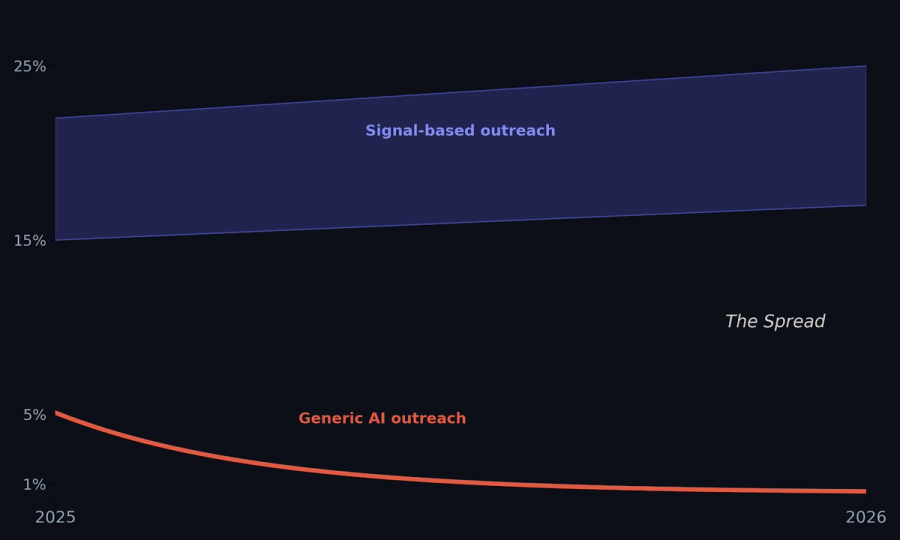
Generic AI outreach is now producing reply rates below 1% across most B2B sectors. Signal-based, ICP-locked outreach is hitting 15–25%. That's not a marginal difference; it's a 15 to 25x spread, confirmed independently by Instantly, Belkins, and Autobound across tens of millions of sends.
The trend line makes the trajectory clear: the average cold email reply rate dropped from 5.1% in 2025 to 3.43% in 2026. That decline isn't evenly distributed. It's concentrated in generic, high-volume sends. The exact category that AI tooling made easier to produce at scale. Meanwhile, the ceiling for signal-based outreach has stayed high. The spread isn't widening because signal-based outreach is getting better. It's widening because generic outreach is getting worse, faster.
The variable separating those two numbers isn't copy quality. It's input quality, i.e. what went into the email before a single word was written.
FAQ: AI cold email and why it stops working
Why are AI cold emails performing so poorly in 2026?
The core issue is structural predictability, not writing quality. Most AI outreach tools produce emails that share the same skeleton. Opening observation, pain point bridge, value proposition, soft CTA. Buyers now recognise this framework at a glance, regardless of how well the individual sentences are written. Recognition triggers dismissal before the content is evaluated.
What's a realistic cold email reply rate benchmark in 2026?
The broad average sits around 3.43%, down from 5.1% in 2025. That number blends generic AI sends with high-performing signal-based campaigns. Generic AI alone sits below 1% in most B2B sectors. Signal-based outreach from well-defined ICPs consistently reaches 15–25%. The benchmark you're competing against depends entirely on which category your outreach falls into.
Does personalisation fix the AI copy problem?
Token-level personalisation; swapping in a first name, company name, or job title doesn't fix it. Buyers in 2026 expect company-level personalisation at minimum: a reference to something specific about the company's current situation, not just its identity. The threshold has moved from "do you know who I am" to "do you know what's actually happening at my company right now."
What is signal-based outreach and why does it perform better?
Signal-based outreach builds the email around a verified trigger. A hiring move, a funding event, a leadership change, a public pain point, rather than around demographic fit alone. The signal is what makes the email structurally different from a template, because it can't be replicated without knowing something real about the recipient's current context.
Why template recognition is the actual mechanism
Woodpecker's analysis of 20 million cold emails found that subject lines signalling AI authorship. Phrases like "Quick question for you" or "Saw you work in [industry]" now actively suppress open rates. Buyers have learned the vocabulary of automated outreach, and the detection happens before the body copy is ever reached.
Reachoutly's analysis puts it more directly: AI tools didn't just speed up writing; they standardised it. The problem isn't that buyers think your email is low quality. It's that they've pattern-matched the structure and already know what the next three sentences say.
This is a structural problem, not a copywriting one. Swapping in a better adjective or tightening the CTA doesn't change the email’s shape. And shape is what's being detected.
The implication is significant: personalisation that operates only at the token level, i.e., name, company, title, leaves the underlying framework intact and visible. What actually breaks template recognition is context that couldn't have been generated without knowing something specific about the recipient's current situation. A reference to a role they're actively hiring for. A connection to a pain point they've stated publicly. A trigger that makes the email structurally impossible to replicate at scale without real signal input.
That's the floor. Not "personalised" in the conventional sense but contextually grounded in something real and current.
What this means for how outreach gets built
The practical implication isn't "write better emails." It's "change what goes into the email before writing starts."
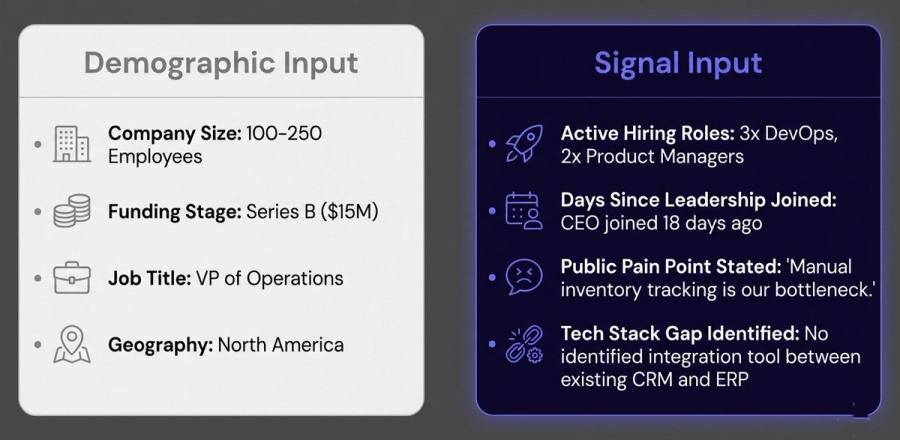
Consider the difference between two inputs for the same outreach target:
Demographic input: Series B SaaS company, 40 employees, VP of Sales title, US-based.
Signal input: Series B SaaS company, actively hiring two SDRs and a RevOps manager; VP of Sales joined 60 days ago, recently posted publicly about pipeline visibility problems.
The first input produces a template. The second produces an email that's structurally impossible to replicate without knowing those specifics because the content is built around what's actually happening, not just who the company is on paper. That's the difference buyers are detecting, and it's the difference the reply rate data is measuring.
Signal-based outreach starts with a verified trigger and builds backwards: what does this company's current situation tell us about what they actually need right now, and does that match what we offer? If the answer is yes, the email writes itself in a way that can't be templated. If the answer is unclear, that's not a copy problem. It's an ICP definition problem, and more sends won't solve it.
The 15–25x reply rate gap in the data isn't evidence that some people write better emails. It's evidence that some teams know something real about the people they're emailing before they start writing. The copy is downstream of that.