Why AI-Personalised Emails Still Get Ignored nd What Real Personalisation Actually Requires
BLOG · OPERATIONAL EFFICIENCY · EMAIL SCRIPT WRITING
Est. read time: 7 min · Last updated: June, 2026
You did everything right. You built a list. You ran it through an AI tool. You launched a "personalised" sequence. And then, silence. Maybe a 2% reply rate. Definitely zero clients.
Here's the uncomfortable truth: most AI-personalised outreach isn't personalised at all. It's automated. Those are different things. This post breaks down why and what separating the two actually looks like in practice.
What is cold email personalisation, and why does it matter for reply rates?
Cold email personalisation means tailoring your message to something specific and relevant about the recipient, not just inserting their first name or company name.
It matters because reply rates collapse without it. The average cold email reply rate sits at 5.1% overall, but drops to around 2% when list quality is poor. Regardless of how "personalised" the AI copy sounds. When prospects see the same surface-level hook hundreds of times a day, they stop reading after the first line.
Personalisation isn't a copywriting trick. It's a data problem.
Why do AI-personalised emails still feel generic?
Because most AI outreach tools personalise the wrong layer.
They take a name, a job title, and maybe a LinkedIn headline, then wrap it in a template that sounds like it was written by someone who Googled "professional email tone." The output is grammatically clean and contextually empty.
The problem: AI generates more volume, not better messages. Approximately 90% of AI outreach is currently rated as "garbage" by the prospects receiving it. The tools aren't broken, they're just automating a step that isn't the bottleneck.
The bottleneck is the signal. What triggered the outreach in the first place? A funding round, a leadership change, a hiring spike; that's context worth writing about. "Hi [First Name], I noticed you're the [Job Title] at [Company]" is not.
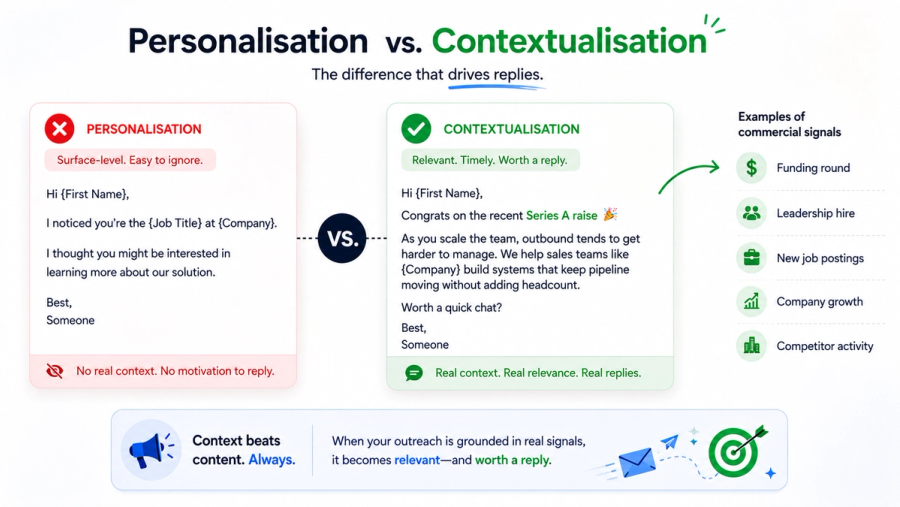
What's the difference between personalisation and contextualisation?
Personalisation: referencing something about the person (name, role, company).
Contextualisation: referencing why you're reaching out now, grounded in a real commercial signal.
Contextualisation drives replies. Personalisation alone doesn't.
Examples of commercial signals worth building copy around:
- A company just raised a Series A (growth pressure, new headcount, new tools budget)
- A senior hire just joined (new decision-maker, new priorities)
- A job posting for an outbound SDR role (they're scaling sales, they need infrastructure)
- A competitor just got acquired (market disruption, switching window)
These signals tell you why this prospect is warm right now. That's the foundation of a message someone actually reads.
What is signal-based outbound, and how is it different from traditional outreach?
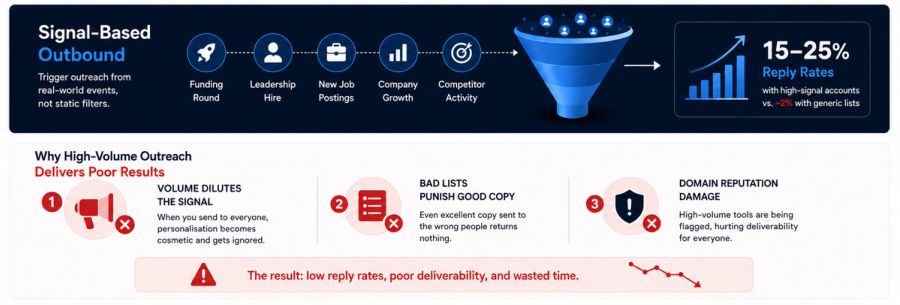
Signal-based outbound means your outreach is triggered by a real-world event, not just by someone matching a firmographic filter.
Traditional outreach: export everyone with the right job title in the right industry.
Signal-based outbound: reach out to companies showing active buying behaviour right now.
The practical difference is dramatic. Teams that cut their list by 90% and focus only on high-signal accounts report reply rates in the range of 15-25%, versus the 2% you get from spraying a generic list.
This approach requires two things most teams skip: a well-defined ICP and live enrichment data that surfaces signals rather than just static firmographics.
What is ICP, and why must it come before outreach?
ICP stands for Ideal Customer Profile, the precise definition of the type of company and buyer most likely to convert, retain, and expand.
It has to come before outreach because without it, there's no way to know which signals are relevant. A hiring spike means something different for a SaaS company than it does for an agency. A funding round matters more if you're selling to growth-stage startups than to enterprise procurement teams.
Every major lead gen failure traces back to the same root: skipped ICP definition and went straight to exporting contacts.
Teams with a strictly defined ICP achieve a 68% higher win rate than teams that skip this step. That number comes from practitioner consensus, not theory.
How long does it take to define a proper ICP?
For teams with existing customers, the rigorous version takes days to weeks. It typically involves pulling a closed-won cohort from your CRM, analysing win/loss patterns, reviewing firmographic and technographic commonalities, and running customer interviews to validate assumptions. Done properly, it's not a quick exercise, and shortcuts here are usually why the ICP ends up too broad to be useful.
For early-stage founders and small teams without that data yet, the input set is different. You're working from founder intuition, early customer conversations, and market observation rather than historical pipeline. A structured questionnaire, one that knows which signals to extract from qualitative inputs, can compress that into 10–15 minutes without sacrificing the targeting precision that matters downstream.
The distinction matters: 10–15 minutes isn't a shortcut for teams who have CRM data to analyse. It's the right-sized process for teams who don't, and who would otherwise skip ICP definition entirely because the "proper" version feels out of reach.
Why do high-volume outreach tools keep delivering poor results?
Three compounding reasons:
1. Volume dilutes the signal.
When you're sending 500+ emails a week, you can't selectively target. Everyone on the list gets roughly the same message. The "personalisation" becomes cosmetic.
2. Bad lists punish good copy.
Even excellent copy sent to the wrong people returns nothing. If the list isn't grounded in a real ICP, the AI's job is to polish something that was never going to convert.
3. Domain reputation damage.
High-volume tools are being directly implicated in deliverability problems with spam flag rates as high as 95% in some cases. This means even your best emails stop reaching inboxes. You're not just wasting effort; you're actively damaging your sender domain for future campaigns.
What does high-quality outbound actually look like for small B2B teams?
For teams without a dedicated RevOps function, typically solo founders or small sales teams of 2–5 people, the winning approach looks like this:
- Fewer, better leads sourced against a defined ICP, not pulled from a broad export
- Enriched with live signals, not just static contact data
- Contextual copy written around a specific trigger, not a template with variables
- Lower send volume that protects the domain reputation and improves deliverability
- No orchestration overhead tools designed for enterprise scale add complexity, not results, at this team size
The benchmark shift is stark: a well-trimmed, signal-grounded list outperforms a bloated generic list by a factor of 10 on reply rate, 20% vs 2%.
Is Clay a good tool for small B2B teams doing outbound?
Clay is a powerful data orchestration platform built for teams with RevOps resources, technical capacity, and the budget to support credit-heavy workflows.
For solo operators and small teams without that infrastructure, it's frequently cited as overkill, not because it doesn't work, but because it's an orchestration engine being used to do a data provider's job. The credit model in particular has been a friction point: teams burning through $800 in a week on simple enrichment tasks that don't require that level of complexity.
The honest answer: if you have fewer than five outbound reps and no RevOps person, Clay's power-to-overhead ratio doesn't fit your workflow.
What should I look for in a cold email personalisation tool?
Look for tools that address the full causal chain, not just the output layer:
ICP Definition (Ideal Customer Profile)
- What it does: Establishes exactly who you are targeting and why.
- What breaks without it: Your copy has no targeting foundation, meaning you're writing without a clear audience in mind.
Lead Enrichment
- What it does: Pulls live, multi-source data on your target accounts.
- What breaks without it: Your data and buying signals become stale or miss critical details entirely.
Signal Detection
- What it does: Identifies specific buying triggers in real time.
- What breaks without it: Your outreach loses its timing and becomes generic, rather than relevant to what the prospect is experiencing right now.
Copy Generation
- What it does: Builds highly contextual messages tailored around those detected signals.
- What breaks without it: Your messaging output drops in quality and just sounds like noisy, automated templates.
Tools that only address the last row, copy generation, are automating the wrong layer. The personalisation problem starts two steps earlier.
What is a realistic benchmark for cold email reply rates in 2026?
Based on current practitioner data:
- Overall average: ~5.1% reply rate across cold email campaigns
- Poor list quality: drops to ~2%, regardless of copy quality
- High-signal, ICP-grounded lists: reported at 15-25% by teams that cut list size by 90% and focused only on in-market accounts
The gap between 2% and 20% isn't a copywriting gap. It's a targeting and signal gap.
Summary
If your AI-personalised emails aren't performing, the fix isn't better AI. It's better inputs.
Real personalisation requires:
- A defined ICP that tells you who belongs on the list
- Live enrichment that surfaces commercial signals
- Copy grounded in why now, not just who
The tools that skip steps one and two are automating the wrong layer, and no amount of personalisation tokens fixes a targeting problem.
RELUMIT is an ICP inference and outbound automation tool built for solo founders and small B2B teams. It infers your ICP from a structured input session and uses it to drive enrichment, signal detection, and contextual script generation without the overhead of enterprise-grade orchestration platforms.
Join the waitlist