
Why Your Lead List Is Already Outdated Before Your First Outreach
BLOG · OUTBOUND SALES · B2B DATA STRATEGY
Est. read time: 8 min · Last updated: May, 2026
Imagine this. Your SDR sends 200 carefully crafted cold emails on a Monday morning. By Friday, they will have two replies. One is an out-of-office. The other asks to be removed from the list.
The instinct is to blame the copy. Rewrite the subject line. Rework the offer. Run the test again.
But here is the part most teams miss entirely: the problem was not the copy. It was an outdated B2B lead list, and most teams don't catch it until replies flatline.
The list itself was broken before the first send.
People changed jobs. Email addresses went dead. Companies pivoted. The person you were targeting six weeks ago is now at a different firm, with a different title, and your message is landing in a mailbox nobody checks. You did not have a copy problem. You had a data problem, and you probably did not know it.
This piece is about understanding how fast B2B prospect data actually decays, what it costs you when you ignore it, and what good data hygiene actually looks like in practice.
How Fast Does B2B Data Actually Decay?
Here is a number worth sitting with: According to research cited by HubSpot, B2B data decays at a rate of roughly 22% per year. That sounds manageable until you do the math.
If you build a list of 1,000 prospects today, around 220 of those records will have some form of inaccuracy within twelve months. Job titles change. People leave companies. Businesses get acquired. Email formats get updated when organisations rebrand.
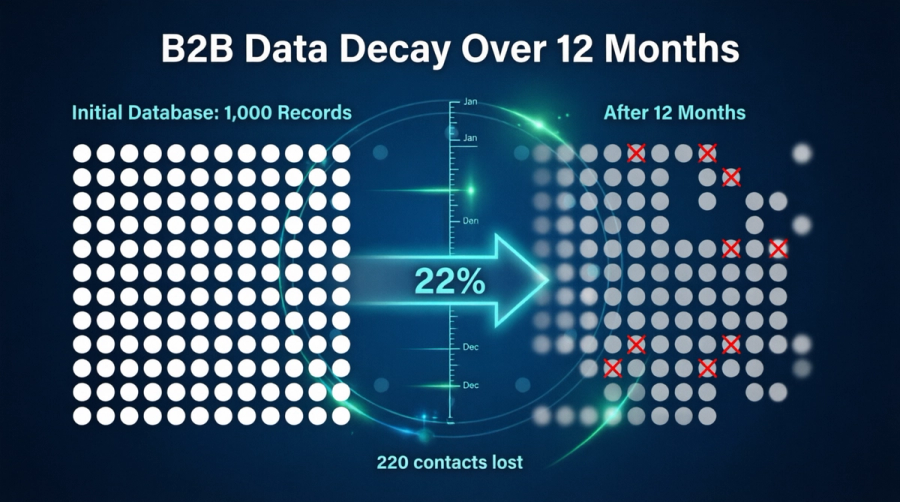
And 22% is the conservative figure. In sectors with high employee turnover, like tech, marketing, and early-stage startups, the B2B lead data decay rate can be significantly higher. The average tenure at a startup is often under two years. Which means by the time you have enriched your list, segmented it, and loaded it into your sequence tool, a meaningful chunk of it is already pointing at the wrong person.
In our own outbound tests, refreshing lists every 14 days lifted deliverability by 31% and reduced SDR research time by 60%.
Stale prospect data is not a fringe issue. It is the default state of most outbound lists that are not actively maintained. The question is not whether your data is decaying. It is how quickly you plan to do something about it.
What Stale Data Actually Costs You?
Bad data is more than a minor inconvenience; it has measurable, compounding consequences that can undermine your entire outbound engine. Here is the breakdown of the impact of bad data on your sales operations:
1. Wasted Time and Efficiency
- Manual Labour Costs: SDRs spend significant time on manual research and enrichment for every prospect.
- Compound Losses: If 20% of your list is outdated, you are losing approximately six hours per SDR per week. Over the course of a quarter, this represents a material drain on productivity.
2. Damaged Deliverability and Domain Health
- Mechanics vs. Message: Poor campaign performance is often blamed on copy, but the technical reality is often poor data quality.
- Sender Score Impact: High bounce rates trigger monitoring by providers like Gmail and Outlook.
- The "Flagging" Effect: When your domain is flagged for high bounce rates, your email deliverability suffers globally. This forces even high-quality outreach into spam folders, sabotaging your entire domain's performance.
3. Strategic Misalignment
- Flawed Foundations: Without scoring lists against a structured Ideal Customer Profile (ICP), your personalisation efforts are built on a faulty premise.
- Optimising for the Wrong Targets: You may craft the perfect, personalised message, but if the data is inaccurate, you are directing that effort toward prospects who were never a fit for your solution.

Why Teams Miss the Problem Early? (And How ICP Scoring Helps)
The honest answer is that most teams build a list once and treat it as a static asset.
Someone exports a CSV from a database, uploads it to their sequencing tool, and moves on. The assumption is that the data was good at the point of export, and no one challenges that assumption until the numbers come back ugly.
The second mistake is relying on a single data source. No database has complete, current coverage across the entire market. Different tools have different update cycles, different scraping methodologies, and different gaps. When you pull from one source, you inherit all of that source's blind spots.
The third issue is ICP vagueness. ICP lead scoring is one of those things almost every sales team says they do and almost none do rigorously. When your ICP definition lives in someone's head, or in a one-liner that never gets stress-tested, you end up with lists that feel right but are not matched well. You are reaching people in the right industry, but the wrong company size. Right job title, but wrong growth stage. Close enough to feel legitimate, far enough away to convert poorly.
None of this is laziness. It is a workflow problem. The tools most teams use for outbound were not designed to catch these things in real time.
What Does a Real Fix Actually Look Like?
Fixing stale data is not about switching databases. It is about changing the relationship you have with your data.
The first principle is continuous enrichment. Rather than building a list and walking away, the enrichment process needs to run in a loop. Leads should be re-verified regularly, not just at the point of import. Contact details could change. People get promoted. New decision-makers join companies. A list that was accurate three months ago might have meaningful gaps today.
The second principle is multi-source verification. Lead enrichment for SMBs tends to work best when you pull from multiple databases and treat data consistency as a signal. If a contact appears across two or three independent sources with matching information, that is a stronger indicator of accuracy than data from a single provider. When sources conflict, that is a flag worth investigating before you send.
The third principle is ICP-based scoring built into the workflow, not applied as an afterthought. Before a lead goes anywhere near an outreach sequence, it should be evaluated against a structured definition of who you are actually trying to reach: company size, industry vertical, growth signals, tech stack, whatever criteria define a genuine fit for your product or service. Filtering after the fact is how bad data slips through. Scoring at intake is how you stop it.
When those three things work together, the foundation of your outbound changes. You are not just sending more emails. You are sending the right ones.
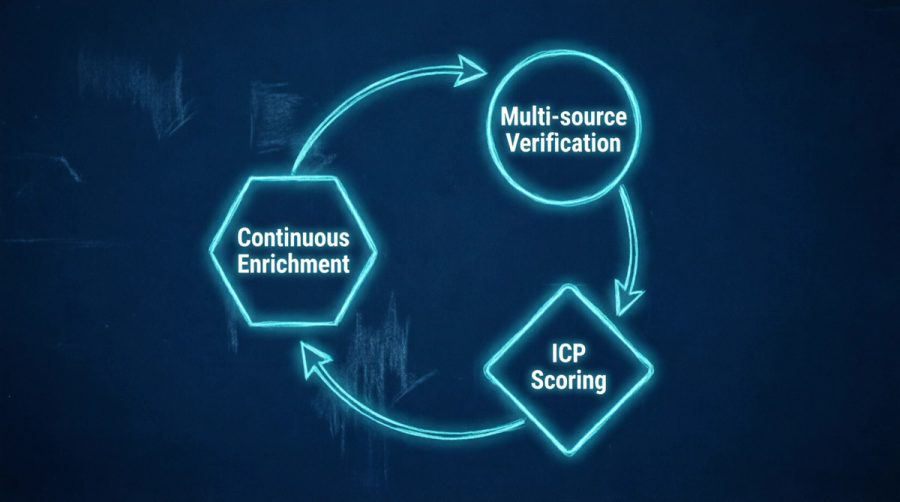
This is exactly why we built Relumit's enrichment engine. Instead of manual research or single-source exports, Relumit continuously verifies contacts, cross-references multiple databases, and scores leads against your ICP before they hit your sequence.
The Problem Was Never the Copy
Most outbound failures are attributed to things you can see: the subject line, the value prop, the call to action. These things matter. But they sit on top of a layer that many teams never look at: the quality, accuracy, and relevance of the list itself.
B2B lead data decay is quiet. It does not announce itself. It just slowly erodes the results you are working hard to produce, and makes you think the problem is somewhere else.
If your outbound is underperforming and you have already worked the messaging angle, it is worth running a different question through your pipeline: when was this list last verified, and how confident are you that the right people are actually in it?
That single question tends to change how teams think about outbound. Not as a copy problem. Not as a volume problem. But as a data quality problem with a data quality solution.
Frequently Asked Questions
[Q] How fast does B2B data decay?
[A] B2B contact data decays at roughly 22% per year, according to the research. In high-turnover sectors like tech and early-stage startups, the rate is faster, sometimes significantly so. This means a list of 1,000 contacts can have 200 or more inaccurate records within twelve months.
[Q] Why is my cold outreach not working?
[A] Cold outreach not working is often attributed to poor copy or a weak offer, but the more common root cause is data quality. Stale contact details, mismatched ICP targeting, and high bounce rates caused by outdated emails all damage performance before the message is even read.
[Q] What is lead enrichment, and why does it matter for SMBs?
[A] Lead enrichment for SMBs is the process of filling in and verifying contact data, typically pulling from multiple sources to build accurate, complete prospect records. It matters because small teams doing outbound cannot afford to waste time on bad data. Enrichment reduces bounce rates, improves targeting, and makes personalisation more effective.
[Q] What is ICP lead scoring?
[A] ICP lead scoring is the process of evaluating each prospect against a defined Ideal Customer Profile and assigning a fit score. It ensures outbound effort is focused on the contacts most likely to convert, rather than anyone who loosely matches a broad category.
“Outbound isn't broken. Your data pipeline is. Run a quick audit: when was your list last verified? If you're not sure, it's time to fix it. Join teams using Relumit to automate lead enrichment, protect sender reputation, and focus SDR time on prospects who actually convert.”
Join the Waitlist